
NAMIBIA AT A GLANCE
In this section we look at where in the world Namibia is located. We share
the basic facts and the things that set us as a nation apart. You will discover
our diverse landscapes, our vibrant communities, and our unique heritage.
NAMIBIA IN THE WORLD


A PROUD COUNTRY IN SOUTHERN AFRICA

GLOBALLY COMPETITIVE INFRASTRUCTURE

THE DIFFERENT REGIONS IN NAMIBIA

A COUNTRY OF DIVERSE LANDSCAPES

A GLOBAL LEADER IN CONSERVATION

THE THINGS THAT SET US APART
-
One of the first countries in the world, to enshrine the protection of its environment in its constitution;
-
Namibia is a global leader in conservation, with vast areas designated as community-based conservancies;
-
The largest population of cheetahs in the world;
-
Namibia has the world’s largest black rhino population.
-
Namibia is home to some of the largest sand dunes
in the world. -
The second-largest canyon on Earth, the Fish River Canyon finds its home in Namibia;
-
Namibia is home to one of Africa's largest concentrations
of rock petroglyphs in Twyfelfontein;


-
Home to the Namib Desert, the world’s oldest desert, featuring the iconic Sossusvlei dunes, which are among the tallest in the world, and the surreal Deadvlei, with its striking contrast of white clay pans, blackened trees, and red dunes;
-
Located along the remote and rugged Skeleton Coast, Skeleton Bay (also called Donkey Bay) is famous for offering one of the longest and most powerful left-hand barreling waves in the world;
-
Rich in cultural diversity, Namibia is home to Africa’s oldest tribe, the San people (over 30,000 years old), also known as the Bushmen, and the OvaHimba, renowned for their red ochre body paint and intricate jewelry.
-
Namibia is ranked amongst the world’s most politically stable countries;
-
Holds some of the finest gemstone quality diamonds in the world;
-
The first country in Africa to export beef to China, EU and USA;
-
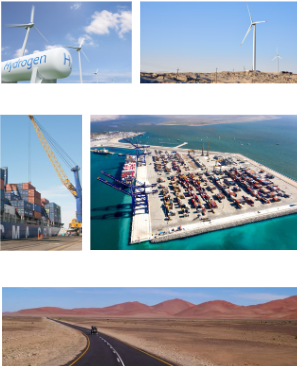
The solar potential in Namibia is one of the highest in the world, with the highest levels stretching down the west of the country;

-
Namibia is uniquely endowed with natural resources critical for the worlds decarbonization ambitions;
-
The congestion-free port of Walvis Bay offers significant shipping time savings, up to five days, to Europe and the Americas compared to other regional ports.
-
Namibia serves as an alternative launchpad into the Southern African Development Community (SADC) market, which includes 330 million people.
-
In the last decade Namibia boasted modern, well-developed infrastructure. In 2024, Namibia ranked #1 for the best road infrastructure on the continent.
INTERNATIONAL RANKINGS


ACCESSING NAMIBIA – POINTS OF ENTRY

REGIONAL & INTERNATIONAL CONNECTIONS
-
Namibia is well-connected by land, sharing borders with Angola, Zambia, Botswana, and South Africa, which facilitates overland travel into the country. You can enter Namibia by road from neighboring countries through several key border crossings, primarily between Namibia and South Africa. Notable routes include the Trans-Kalahari Highway, linking Botswana and Namibia, and the Orange River crossing from South Africa.
-
To streamline cross-border travel, the Namibia Revenue Agency has partnered with Botswana Unified Revenue Services to pilot the One Stop Border Post at the Trans Kalahari and Mamuno borders. This initiative aims to simplify customs and immigration procedures, making it easier for travelers and goods to move between countries.
-
The Walvis Bay Corridor Group plays a crucial role in enhancing Namibia's position as a transport hub for regional and international trade. Established in 2000, the WBCG promotes the utilization of the Walvis Bay Corridors, which comprise an integrated system of well-maintained tarred roads and rail networks. These corridors provide vital access for landlocked Southern African Development Community (SADC) countries to transatlantic markets.
-
Through the world-class commercial port at Walvis Bay, international shipping connection and the added advantage of being a gateway to the west coast of Africa, Namibia plays an increasingly important role in trade, linking the global economic centres to over 330 million consumers in southern Africa.

GATEWAY TO AFRICA
-
Trans-Kalahari Corridor: Connecting Walvis Bay to Gaborone and Gauteng in South Africa.
-
Walvis Bay-Ndola-Lubumbashi Development Corridor: Previously known as the Trans-Caprivi Corridor, it links Namibia with Zambia and the Democratic Republic of Congo.
-
Trans-Cunene Corridor: Extending through northern Namibia into southern Angola.
-
Trans-Oranje Corridor: Linking Walvis Bay with South Africa's Northern Cape Province.
These corridors not only facilitate trade but also significantly reduce transit times for imports and exports, making Namibia an attractive gateway for businesses.
The WBCG has achieved remarkable growth in cargo volumes along these routes, now standing at approximately 2.4 million tons per annum.
With ongoing improvements in transport infrastructure and a commitment to trade facilitation, including 24-hour border operations along the Walvis Bay Corridors, reaching Namibia has never been more accessible. Whether traveling for business or leisure, visitors can enjoy seamless connectivity to this vibrant nation.

LOGISTICS HUB
